




The best LLM rank tracking tool depends on what you actually need to measure: brands that want full SEO plus AI visibility usually fit broader platforms, while agencies, enterprise teams, and AI-first marketers often need a dedicated tool for citations, mentions, competitors, prompts, and cross-platform visibility. In 2026, LLM tracking matters because users increasingly ask ChatGPT, Gemini, Perplexity, and other AI systems for recommendations, so a brand can rank in Google and still be missing from the answer that shapes the buying decision.
- What Are LLM Tracking Tools and What Do They Actually Monitor?
- What Does an LLM Rank Tracker Actually Do for a Brand?
- What Metrics Does an LLM Rank Tracker Measure?
- Why Does LLM Rank Tracking Matter for Real Business Decisions?
- Why Don’t Traditional Rank Trackers Show the Full Picture Anymore?
- Why Do Marketing Agencies Need LLM Rank Tracking Now?
- Should You Trust API-Based Tracking or UI-Based Tracking More?
- How Do LLM Rank Trackers Collect AI Answers?
- Which AI Platforms Should an LLM Rank Tracker Cover?
- What Features Actually Matter When Choosing an LLM Rank Tracker?
- Why Is AI Visibility Tracking Now Essential for Search Everywhere?
- What Types of AEO and GEO Tools Exist Today?
- How Should You Evaluate LLM Rank Tracking Tools Fairly?
- How Should Agencies Compare LLM Rank Tracking Platforms?
- Which LLM Rank Tracking Tools Stand Out at a Glance?
- What Are the 6 Best LLM Rank Tracker Tools for Different Use Cases?
- Which LLM Tracking Tools Fit Marketing Agencies Best?
- Is SE Ranking the Best Choice for SEO and LLM Tracking Together?
- Is Profound the Right Enterprise LLM Visibility Platform?
- Is Peec AI a Smart Option for Prompt Tracking and Competitive Monitoring?
- Is Ahrefs Brand Radar Good for AI Visibility and Backlink-Led Research?
- Is Semrush a Good Fit if You Want AI Visibility Inside an SEO Suite?
Brand search visibility has changed faster than many SEO teams expected. In traditional search engines like Google and Bing, the old model was simple: track keyword rankings, look at classic blue links, and judge whether a page moved up or down. That still matters, but it no longer tells the full story when AI-assisted results and generated answers sit between the searcher and the website.
The practical shift is easy to see. More than 900 million people use ChatGPT weekly, and AI Overviews now appear in nearly half of searches. That means B2B buyers, enterprise teams, and marketing agencies are no longer just measuring a page’s position in a traditional search results page. They are measuring a new visibility gap: whether an AI answer engine names, cites, or ignores the brand when users ask for products, services, companies, or a recommendation.
In my experience, that is why the market for LLM tracking tools exploded so quickly. A new generation of software now focuses on citation tracking, brand mention frequency, answer engine visibility, and prompt-response accuracy. There are already dozens on the market, and the hard part is no longer finding a tool. The hard part is finding the right tool for the right problem, not just the tool with the longest feature list.
What Are LLM Tracking Tools and What Do They Actually Monitor?
LLM tracking tools are specialized applications that monitor how often a brand, business, product, or website appears in answers across AI search systems, LLM chatbot apps, and related AI platforms. Unlike traditional SEO rank trackers, which focus on a URL position in a SERP, these tools analyze the output of conversational AI and record whether a target brand is named, cited, or missing.

At a minimum, the basic function is simple: the tool will run a prompt on ChatGPT, Perplexity, Google’s AI Overviews, AI Mode, or similar systems, then inspect the reply for mentions, text, citations, and exact context. A strong platform goes further. It tracks how visibility is changing over time, how competitors appear on the same tracked prompt, and whether the answer uses your own web pages or outside data sources.
That is why the right framing is not “where do I rank?” but “do I appear in the answer?” A digital marketing agency might rank on page one for “best SEO agency in New York,” yet still be not mentioned when a potential customer asks, “what are the best SEO agencies in New York.” That gap is exactly what marketers are now trying to measure, improve, and compare across different AI models.
What Does an LLM Rank Tracker Actually Do for a Brand?
An LLM rank tracker tool automates the work you would otherwise do by hand across a dozen browser tabs, then turns those observations into structured, comparable data. Instead of only tracking keyword rankings in blue links, the system checks whether a brand appears in AI responses, whether it shows up in AI Overviews, whether search queries trigger competitors, and how that visibility compares across multiple AI platforms.
The practical workflow is usually consistent. You create a prompt list, add competitors, and let the platform perform scheduled runs. The tool handles answer capture, brand extraction, URL extraction, and then produces trend reports and exports. That is the operational difference between old traditional SEO measurement and the newer LLM-focused layer: the older model measures where a page ranks, while the newer one measures whether the brand is being understood as an authority.
The best implementations also expose the hidden parts of the process, which matters more than most teams expect. A dashboard that only shows a score is less useful than one that surfaces raw data, explains the collection method, and lets you check exact cited URLs. When AI systems build shortlists for a buying question, the real value comes from knowing not just that you lost visibility, but how the answer was collected and why the system preferred another source.
What Metrics Does an LLM Rank Tracker Measure?
An LLM rank tracker usually measures a mix of visibility, citation, competitor, and trend signals rather than one static ranking number.
- Prompt visibility: whether the brand appears for a tracked prompt
- Brand mentions: whether the answer names the brand or product
- Answer position: whether the brand is named early or after rivals
- Citations and cited URLs: whether the answer uses your pages or third-party sources
- Competitor visibility: which rivals appear on the same prompts
- Sentiment: how the answer describes the brand
- History: how the signals changes across runs and weeks
The detail that many teams miss is that mentions and citations are separate signals. An AI system might name you without linking your site, or it may cite your page while recommending someone else. A useful tracker has to report both, because the underlying visibility story changes depending on which one you win.
Why Does LLM Rank Tracking Matter for Real Business Decisions?
LLM rank tracking matters because a brand can lose a customer before a click ever happens. If someone asks ChatGPT for the best SEO agency, and your company is not included, the battle happened without your team even seeing it.
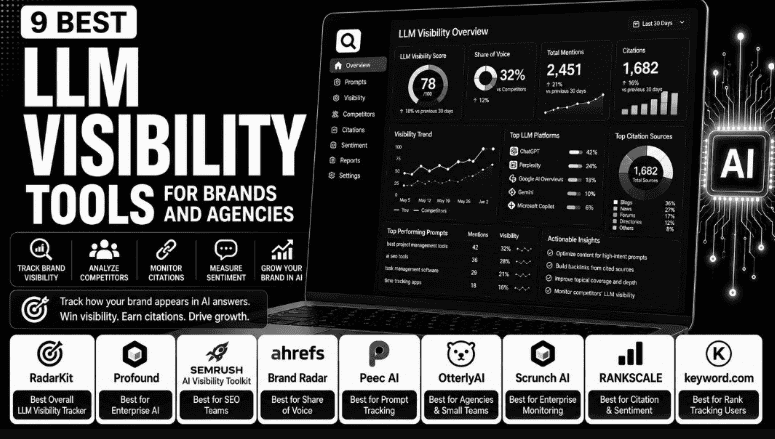
That is the real risk inside modern AI search environments. Purchase decisions increasingly happen at the answer layer, where users may never click a link. Old-school tools do not monitor interactions there well enough, so brands can be quietly losing ground while dashboards still look healthy. I’ve seen teams assume rankings were stable, only to discover later that they were missing from the questions that mattered most commercially.
The reason LLM tracking tools are different is that they bring visibility to visibility. They show whether AI engines cite you correctly, misrepresent your offerings, or forget you exist entirely. That gives a team a more realistic strategic roadmap for content creation, entity optimization, and brand mentions, so what the company publishes lines up more closely with how AI understands your brand.
Why Don’t Traditional Rank Trackers Show the Full Picture Anymore?
Traditional rank trackers no longer show the full picture because search behavior has shifted from link selection to answer consumption. For years, SEOs lived and died by one measurement: where a page sits in Google’s blue links. If a page ranked number one, teams celebrated. If it ranked number ten, they panicked and refreshed the dashboard five times. That world has not disappeared, but it is no longer the whole market.
Now Users are asking search queries in natural language, expecting full, conversational explanations, and often getting them directly through AI-generated results. When Google answers the question, many people never click. Classic rank trackers still follow web pages in Google search results, and they can still alert you when something move up or drops down a position. The problem is that many users never see those rankings.
The answer layer now includes AI Overviews, Google AI Mode, Answer engines like Perplexity, Voice search responses, and Recommender-style responses powered by LLMs. These are the new gatekeepers, and they often skip linking. That is why a familiar SEO dashboard can suggest you are doing great while your visibility in AI search is quietly plummeting.
Why Do Marketing Agencies Need LLM Rank Tracking Now?
Marketing agencies need LLM rank tracking now because they manage visibility for multiple brands at the same time, and AI search has made that work more complicated than checking one website every few days. Agency clients still care about rankings, but they also want to know why a rival is surfacing in AI answers while their own brand is absent.
The biggest operational reason is that Search behavior is changing. Customers are using AI tools to research businesses, products, software, and services. Instead of searching ten websites and comparing manually, they may ask an AI platform for a shortlist. If the client missing from that answer, the agency now has a new kind of visibility problem to explain and fix.
The reporting pressure has changed too. Clients still ask simple commercial questions, but the answers are getting harder. “Why is my competitor recommended by ChatGPT?” is not easy to answer without evidence. Agencies increasingly need platforms that show which competitors appear more frequently, which topics and prompts trigger mentions, and how to turn those findings into simple reports that are easier to understand and share.
Should You Trust API-Based Tracking or UI-Based Tracking More?
You should trust the method that best matches your decision-making need, because API-based and UI-based tracking reveal different parts of AI visibility.
| Tracking method | Typical strengths | Typical weaknesses |
| API-based tracking | Fast, Low Resource needs, High Scalability | Often produces answers different from the typical user experience, fewer Rich features |
| UI-based tracking | Captures what a typical user sees in the app, includes shopping snippets and other rich results | Slower, more expensive, harder implementation |
The practical tradeoff is about realism versus scale. API connection setups are usually easier to scale and cheaper to run, but they may return answers that do not look like the output inside the consumer interface. UI-based tracking is often closer to the actual result a user sees, which is why many teams prefer it for competitive monitoring even when it comes with a higher price point.
How Do LLM Rank Trackers Collect AI Answers?
LLM rank trackers collect AI answers through app capture, direct API access, or hybrid approaches that sit between the two. Most buyers skip this question, but it often matters more than the dashboard because the answer collection method determines what kind of visibility you are really measuring.
An App capture workflow records what a signed-out user sees in the consumer interface, including web results and citations. API collection calls the model directly, which is usually cheaper, but a plain API call may not search the web, so the answer differs from what users see in the app. Search-enabled API calls can return sources, but they may still differ from the consumer experience.
The other blind spots are Location, language, and repetition. Good tools let you set a country per prompt, decide how many times a prompt runs per check, and inspect the stored records. One of the clearest rules in this category is that One run a day is a sample of one. If the underlying rank tracking data is shallow, every report build on top of it will be shallow too.
Which AI Platforms Should an LLM Rank Tracker Cover?
An LLM rank tracker should cover the AI platforms your buyers actually use, not just the ones with the loudest marketing. For most brands, the practical starting set includes ChatGPT, Google AI Overviews, Google AI Mode, Gemini, Microsoft Copilot, and Perplexity, while Claude matters more in some technical categories.
Platform-level differences are not cosmetic. Each platform needs its own report because each one builds answers differently and surfaces a different number of sources per answer. In one dataset covering 103,427 AI answers and 746,702 citations from September 15 to October 14, 2026, Google AI Overviews averaged about 13.7 links, Gemini about 12.3, ChatGPT about 5.2, Google AI Mode about 4.8, and Microsoft Copilot about 4.5. Those differences affect how scarce a citation slot is and how much room there is for third-party influence.
The simplest mistake is to collapse everything into one score. If a tool blends all platforms into one number, it can hide where you win and where you are absent. That is why platform coverage matters so much in comparison tables: some tools focus on a narrow set, while others expand into Claude, Grok, Meta AI, DeepSeek, or other channels that may matter for a particular industry.
What Features Actually Matter When Choosing an LLM Rank Tracker?
The features that matter most are the ones that help a team trust the data, act on the data, and scale the workflow without surprises.
- Multi-platform coverage matters because users do not all search in one place.
- Repeated runs per prompt matter because AI outputs are volatile and one run can mislead you.
- Exact cited URLs matter more than domain-only reporting because page-level wins and losses drive optimization.
- Competitor tracking matters because visibility is only meaningful relative to alternatives.
- Alerting and change detection matter because a brand can drop out before a quarterly review catches it.
- Pricing transparency matters because seat limits, query caps, and overage fees scale faster than many buyers expect.
- Exports, API, and Looker Studio support matter for agencies and internal reporting teams.
- Actionable Recommendations matter because raw scores do not tell a team what to do next.
A lot of buyers still focus on vanity language like “best” or “most advanced,” but the more useful buying frame is operational. Does the tool show the full answer archive? Does it distinguish being cited as a source from simple mention frequency? Does it help with Prompt or query tracking, Brand mention monitoring, and Citation or source analysis? If the answer is no, the platform may still look impressive in a demo but fail in actual campaign work.
Why Is AI Visibility Tracking Now Essential for Search Everywhere?
AI visibility tracking is essential because modern discovery does not stop at a blue link. Brands still spend the majority of SEO budgets optimizing for search engines, but many users moved on to AI answers for at least part of the research journey. They ask questions in Google AI Mode, ChatGPT, Perplexity, and even social-led conversational search, then expect the best answer instantly.
What changed is where persuasion happens. Decision-making is shifting upstream, and the recommendation is the conversion in many early research moments. That is the logic behind Search Everywhere Optimization: Visibility cannot end at a blue link when the customer now Asks, Researches, Compares, and Decides across interfaces powered by AI.
The brands that win are the ones that track whether AI systems trust them enough to speak clearly about them. That means Reinforcing entity understanding, monitoring which AI search engines trust your expertise, and creating content aligned to how people speak to machines. You really cannot improve what you cannot measure, and that is why AI visibility has become a practical leading indicator rather than a theoretical one.
What Types of AEO and GEO Tools Exist Today?
AEO and GEO tools now fall into a few practical categories, and knowing the category matters almost as much as knowing the brand. The world of GEO is still new, the tools are rapidly evolving, and LLM visibility tracking is only one piece of the puzzle.
The first category is LLM Rank Trackers or AEO/GEO Trackers, where the primary focus is to specialize in monitoring brand presence, citations, and sentiment across various LLMs for a given set of prompts. The second is AI Content Optimization & Generation Platforms, where tools like AirOps help teams create or rewrite content so it becomes more citable while also integrating tracking features to measure impact.
Then there are Enterprise AEO/GEO Suites, which tend to be high-ticket platforms such as Evertune or Bluefish AI with comprehensive brand safety monitoring, crisis detection, crawler analytics, and deep integrations for Fortune 500 companies. Finally, Integrated SEO/AEO Platforms like Semrush or Nightwatch treat LLM tracking as a feature, add-on, or extension inside an existing suite of tools.
How Should You Evaluate LLM Rank Tracking Tools Fairly?
You should evaluate LLM rank tracking tools by method, coverage, usefulness, and value rather than by vendor claims alone. A fair framework starts with AI Platform Coverage, then checks Tracking Accuracy & Method, Competitive Intelligence, Sentiment & Citation Analysis, Actionability, and Pricing & Value.
That order matters because feature volume can distract from fit. A platform with a long comparison page may still fail if it lacks the engines your buyers use or if its method produces unstable results. When I compare tools for teams, I look first at how clearly they explain their tracking model and whether the data would actually change a content or reporting decision.
How Should Agencies Compare LLM Rank Tracking Platforms?
Agencies should compare LLM rank tracking platforms by client fit, reporting fit, and workflow fit rather than by feature count alone. The right platform depends on number of clients, the AI platforms you need to monitor, reporting requirements, and budget.
The smart agency view is operational. Can the platform handle Agency use cases like client segmentation, exports, dashboards, and repeatable reporting? Does it cover AI search visibility tracking, LLM and AI platform coverage, Competitor tracking, and Citation or source analysis without becoming too expensive as the roster grows? Those questions usually matter more than whether the homepage uses the newest acronym.
Which LLM Rank Tracking Tools Stand Out at a Glance?
Several LLM rank tracking tools stand out quickly once you compare them by use case, price, and platform angle.
| Tool | Best-known angle in the visible data | Starting price |
| SE Ranking | broad SEO + AI tracking | $129/month |
| Profound | enterprise-grade monitoring | $99/month, ChatGPT only |
| Peec AI | lightweight brand monitoring | $95/month |
| Ahrefs Brand Radar | backlink-integrated AI visibility | $199/month, one AI system |
| Semrush | AI visibility inside SEO suite | $99/month per domain |
| Surfer SEO | AI tracking + content optimization | $119/month |
| Writesonic | all-in-one GEO + content platform | $249/month |
| Otterly AI | budget-friendly monitoring | $29/month |
| LLMrefs | affordable broad-platform tracking | 79€/month |
| ZipTie.dev | AI search prioritization | $69/month |
What stands out is not that one tool wins every scenario, but that the price-to-purpose ratio changes fast. A team that needs pure monitoring will not choose the same platform as one that wants SEO workflows, agency reporting, or content optimization built in.
What Are the 6 Best LLM Rank Tracker Tools for Different Use Cases?
The six best tools in the narrower comparison view serve different use cases rather than one universal buyer profile. Ranko is framed around Multi-platform LLM visibility, Profound around Enterprise brand monitoring, Otterly.AI around agencies with multiple clients, Peec.ai around Competitive citation tracking, Brandwatch around combined social and AI monitoring, and Mention around small teams with cost sensitivity.
That is a useful reminder that “best” needs context. Some teams need a one dashboard view with a Free plan, some need White-label reporting, and some need Side-by-side competitor mention share. Others care more about whether they can test the product in 7-day windows or whether the Starting price will stay manageable once prompt counts rise.
Which LLM Tracking Tools Fit Marketing Agencies Best?
The best LLM tracking tools for agencies are the ones that make multi-client monitoring, reporting, and pricing manageable. In the visible comparison set, Cairrot, Nightwatch, Peec AI, Semrush AI Visibility Toolkit, and parts of the broader SEO suites stand out because agencies need more than raw monitoring.
The agency problem is not just collecting data. It is turning data into a process that scales. That is why the agency-focused comparison emphasizes API, Free Trial, Looker Studio integration, Pay-per-client pricing, Advanced prompt management, Source analysis, collaborative content management, and whether the platform adds AI visibility without forcing a separate reporting stack.
I’d also be careful with pricing optics here. A low entry point is helpful, but agencies need to examine whether the platform still works after prompt counts, client count, and export requirements grow. In practice, the cheapest tool at onboarding can become the most expensive tool operationally if it creates manual work.
Is SE Ranking the Best Choice for SEO and LLM Tracking Together?
SE Ranking is one of the strongest options for teams that want traditional SEO and AI visibility in the same system. The platform is a visibility tracking platform that combines LLM tracking with a broader suite of traditional SEO tools, and that matters for teams that do not want AI monitoring isolated from audits, keywords, and reporting.
Its LLM layer is built around an AI visibility tracker with UI-based tracking for citations and mentions across AI Overview, AI Mode, ChatGPT, Gemini, and Perplexity. It also adds competitor benchmarking, MCP server integration, and a broader SEO stack that includes Rank tracking, keyword research, site audits, competitive research, GA4 integration, and support for social visibility through Planable. For deeper analysis, there is also SE Visible, which focuses on deeper citation analysis, prompt research, sentiment tracking, and AI competitor research.
Pricing is straightforward by comparison standards: Core at $129/month with 2k keywords and 100 prompts, Growth at $279/month with 5k keywords and 250 prompts, plus a 14-day free trial and 20% annual savings. The upside is a Full SEO + LLM tracking combined experience with agency-friendly reporting and client management. The downside is a Learning curve that can feel steep for beginners, and some Cross-platform data correlation is still manual.
Is Profound the Right Enterprise LLM Visibility Platform?
Profound is a strong fit for brands that need enterprise-grade AI visibility reporting, governance, and broader platform coverage, but it is not designed like a lightweight starter tool. The platform can monitor up to 10 AI answer engines, supports Prompt tracking, Competitor monitoring, and Brand visibility analysis, and is often framed for larger organizations that want CMO-level reporting or deeper insight into how they are represented in AI responses.
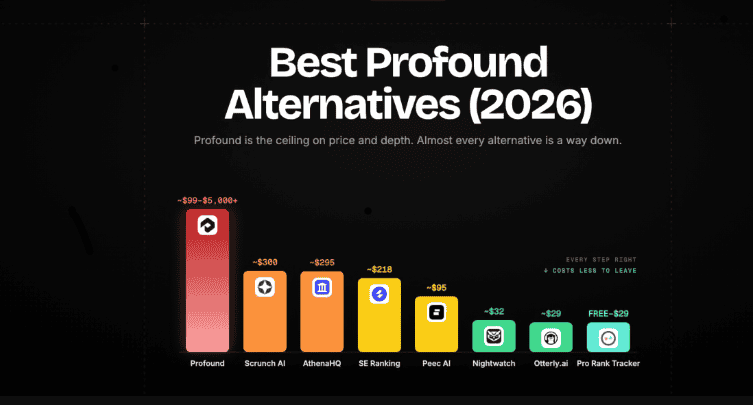
The product angle is clearly enterprise-first. It emphasizes real-time data, AI user agents’ behavior, site-level monitoring, Prompt volume estimates, Agent crawling analytics, and LLM-optimized content or content optimization workflows. It also appears in comparisons alongside governance, security, advanced analytics, and SOC 2 Type II compliance, which is why it is often mentioned for finance, healthcare, regulated industries, and other larger brands with dedicated AEO budgets.
Pricing starts at Starter $99/month for 50 prompts on ChatGPT, then Growth at $399/month for 100 prompts across ChatGPT, Perplexity, and AIO, with Enterprise pricing custom and support for up to 10 engines. In other comparisons, the entry price is shown higher, including $299/mo, which tells you one important thing: enterprise software pricing often depends on plan framing and packaging. The tradeoff is clear too: Powerful enterprise-grade features and ecommerce features can impress large clients, but high pricing, limited lower-tier flexibility, and the lack of a clearly accessible API can make it harder to scale for smaller agency accounts.
Is Peec AI a Smart Option for Prompt Tracking and Competitive Monitoring?
Peec AI is a smart option for teams that want focused prompt tracking, competitive monitoring, and practical visibility reporting without jumping straight into enterprise-level complexity. It is repeatedly positioned around AI search visibility, competitive benchmarking, and helping teams ask deeper questions about how often a brand appears, which sources referenced it, and whether visibility improving over time.
The product’s shape is useful for marketers because it combines monitoring with interpretation. The visible pool points to sentiment, position, prompt set management, suggesting prompts, source analysis, and AI-generated answers across channels like ChatGPT, Perplexity, Google AI Overviews, Google AI Mode, Gemini, and Copilot, with broader coverage reaching 8 AI engines in some descriptions and Claude available in certain tiers or higher tiers. The platform also surfaces Prioritized Actions, Clean User-Friendly Dashboard, Looker Studio, API, and AI-driven strategy recommendations, which makes it practical for agencies that need both insight and client communication.
On pricing, the visible dataset shows several versions: a Starter plan at $95/month, a Pro at $245/month, an Advanced tier at $495, and agency-style plans from $245/month with 10,000 credits. Another visible pricing set frames it in euros with €89/month, €199/month, and higher Enterprise Plan or Add-ons for Gemini, Claude, and other models. The upside is an affordable option, clean UI, strong visibility trends, and useful Pitch Workspaces or agency-oriented workflows. The downside is that core LLMs can be gated behind higher plans, and the tool is more focused on monitoring and strategy than on hands-on execution tools.
Is Ahrefs Brand Radar Good for AI Visibility and Backlink-Led Research?
Ahrefs Brand Radar is good for teams that already trust backlink-led SEO research and want AI visibility layered into that workflow. The product extends the familiar Ahrefs ecosystem into AI search, covering AI Overviews, AI Mode, ChatGPT, Perplexity, and Copilot, while leaning on backlinks, keyword research, content research, and wider competitor analysis to interpret why a brand is visible or invisible.
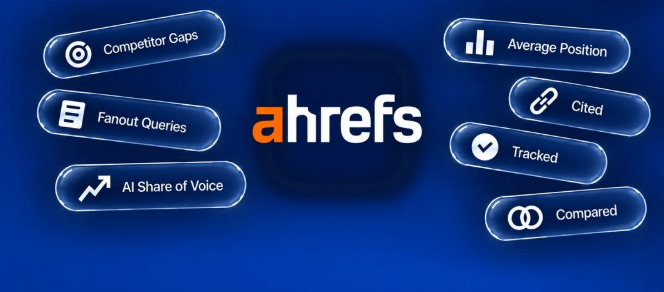
That context is the real advantage. Instead of treating AI discovery as totally separate from organic search, the system helps SEO professionals connect traditional SEO data to AI answers, brand mentions, and web visibility. The tool is also associated with a large database of organic prompts and visibility signals from places like YouTube, Reddit, and even TikTok, which is useful if a team wants to understand not just whether it is cited, but what wider content ecosystem is influencing AI outputs.
Pricing is less friendly for smaller teams: $199/month for one AI engine, $699/month for all engines, 2,500 credits for custom prompts, and $50/month or more for additional credits. The main strengths are strong backlink analysis, an excellent research environment, and broad web context. The limitations are the separate add-on model, steep pricing, and the fact that some AI tracking requirements may still push agencies toward additional tools.
Is Semrush a Good Fit if You Want AI Visibility Inside an SEO Suite?
Semrush is a good fit if your team already works inside a large SEO suite and wants AI visibility as an extension rather than a separate purchase category. The platform brings AI tracking, mentions, analytics, competitor benchmarking, and AI-based suggestions into an established SEO platform, which is why many teams consider it a practical bridge between old and new search workflows.
The visible dataset ties Semrush to ChatGPT, AIO, AI Mode, Gemini, and Perplexity, plus features such as AI Visibility Toolkit, AI Visibility Score, prompt suggestions, missing prompts, sources, sentiment tracking, and LLM content optimization. That makes it more than a simple mention checker, though it still feels like a standalone add-on or extension in some comparisons rather than a fully separate AI-native platform.
Pricing also reflects the suite model. The AI Visibility Toolkit add-on starts at $99/month per project with +25 custom prompts, while Semrush One Starter is $199/month for 50 prompts and one domain, Semrush One Pro is $299/month for 100 prompts, and Semrush One Advanced is $549/month for 200 prompts. The upside is the broader Semrush ecosystem, especially for teams already paying for SEO. The downside is familiar too: steep pricing, low prompt limits, and the sense that AI tracking is still an add-on layered into the suite.